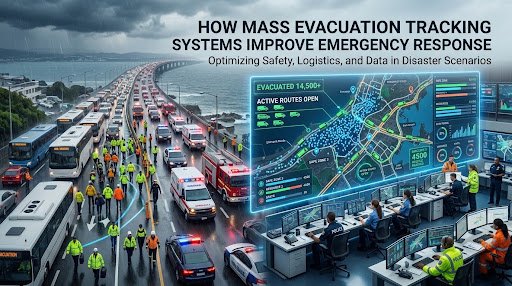
During an industrial emergency, knowing who is on-site, who has reached safety, and who may still be inside a facility can make a critical difference. Large manufacturing plants, warehouses, energy facilities, shipyards, and other high-risk workplaces may have hundreds of employees, contractors, and visitors moving through different areas at the same time. When an evacuation begins, manual headcounts can become difficult, particularly when people move quickly between exits and muster points.
A mass evacuation tracking system uses technologies such as RFID to provide organizations with faster visibility of personnel during an emergency. RFID systems can automatically identify tagged individuals as they pass designated reader points, helping safety teams establish who has evacuated and who remains unaccounted for.
What Is a Mass Evacuation Tracking System?
A mass evacuation tracking system combines RFID tags, readers, software, and designated evacuation or muster areas to automate personnel accountability. Instead of relying entirely on paper lists or verbal roll calls, the system can capture personnel movements electronically and provide current information to emergency coordinators.
For example, active RFID tags can identify multiple people as they pass through monitored locations. Some systems can also provide direction sensing, allowing organizations to distinguish between people entering and leaving an area.
RFID-Based Identification
With RFID technology, employees, contractors, and visitors can carry identification tags that communicate with readers without requiring physical contact or individual scanning. This hands-free approach can be particularly useful when large groups are evacuating quickly.
Real-Time Evacuation Visibility
The resulting information can help emergency teams see which personnel have reached muster points and which individuals remain unaccounted for. This gives responders more actionable information than a simple assumption that everyone has evacuated.
How RFID Improves Personnel Accountability
RFID personnel tracking can reduce the dependence on manual headcounts during stressful situations. Identec’s current emergency mustering information describes systems that can identify multiple tags quickly and generate information about assembled and missing personnel.
Automated RFID Personnel Tracking
When readers are positioned at strategic entry, exit, and muster locations, the system can automatically record personnel movement. This creates a digital record that emergency coordinators can use alongside established evacuation procedures.
Identifying Missing Personnel
A major advantage is the ability to identify people who have not been recorded at a safe location. This information can help first responders prioritize their efforts rather than spending valuable time manually checking entire employee lists.
The Role of a Time and Attendance RFID System
A Time and attendance RFID system can provide useful information about who is currently on-site before an emergency occurs. RFID technology can be used for attendance registration as well as emergency evacuation monitoring, allowing the same identification infrastructure to support multiple workplace functions.
Knowing Who Is On-Site
This distinction matters because employee schedules change throughout the day. Workers may arrive late, leave early, move between buildings, or work different shifts. A current attendance record can therefore give safety teams a more accurate starting point for personnel accountability during an evacuation.
Benefits of an Emergency Muster System
An emergency muster system can make the roll-call process faster and more structured. Automated identification reduces the need for supervisors to manually call every employee’s name while people are gathering at designated assembly points.
Faster Roll Calls
RFID readers can process multiple tagged individuals without requiring each person to stop and scan a badge. This can help maintain the flow of people toward safe areas while still collecting accountability information.
Better Emergency Coordination
Real-time information can also support communication between safety managers and emergency responders. A centralized view of accounted-for and missing personnel can help teams focus their attention where it is needed most.
Supporting Safer Industrial Evacuations
Technology should complement—not replace—well-designed evacuation procedures, employee training, emergency drills, and workplace safety plans. RFID systems are most useful when organizations establish clear muster points, maintain accurate personnel records, test equipment, and train workers to respond correctly.
For facilities evaluating this approach, a Mass evacuation tracking system can provide a technology-based method for improving personnel visibility during large-scale emergencies.
Improving Emergency Preparedness
Regular drills can reveal gaps in evacuation routes, communication, accountability, and system coverage. Organizations can use the information generated by tracking technology to review how effectively personnel were accounted for and identify opportunities to improve their emergency plans.
RFID should therefore be viewed as one component of a broader emergency preparedness strategy. Effective planning still depends on clear responsibilities, trained employees, reliable communication, accessible muster points, and procedures that have been tested under realistic conditions.
Conclusion: Strengthening Emergency Response
A mass evacuation tracking system can give industrial organizations a more efficient way to manage emergency evacuation tracking and personnel accountability. By combining RFID personnel identification, attendance information, real-time visibility, and automated mustering, organizations can reduce reliance on manual roll calls and provide emergency teams with more timely information.
The technology works best when integrated with established safety procedures and regularly tested through drills. For workplaces where large numbers of employees, contractors, and visitors must be accounted for quickly, automated tracking can become an important part of a coordinated emergency response strategy.
FAQs
1. What is a mass evacuation tracking system?
It is a technology-based system that uses RFID or related tracking technologies to identify and account for personnel during emergency evacuations.
2. How does RFID help during an evacuation?
RFID can automatically identify tagged personnel as they pass monitored locations, helping safety teams determine who has reached a muster area and who remains unaccounted for.
3. Can a time and attendance RFID system support emergency response?
Yes. Attendance data can help establish which employees are currently on-site, providing useful information for emergency personnel accountability.
4. What is an emergency muster system?
An emergency muster system helps organizations account for employees, contractors, and visitors at designated assembly points following an evacuation.
5. Does RFID replace emergency evacuation procedures?
No. RFID should support established evacuation plans, emergency training, drills, communication procedures, and workplace safety practices rather than replace them.